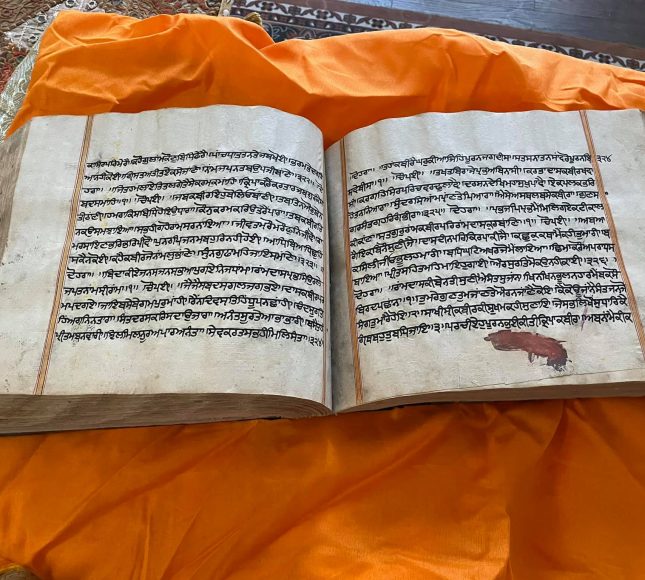
GURPRANALI, a distinct genre in Punjabi historical writing, provides in prose or verse chronological information about the lives of the Gurus and members of their families. The genre mainly records dates of birth, marriage, and death. Occasionally, dates of major events are also mentioned. The genre gained vogue in Sikh times in the first half of the nineteenth century and has continued to claim adherents in the twentieth. For the history of early Sikhism, the gurpranalis along with janam sakhis constitute serviceable source material.
Most of the earlier gurpranalis remained unpublished during the lifetime of their authors. It was only recently that Bhai Randhir Singh compiled an anthology of gurpranalis, published by the Shiromani Gurdwara Parbandhak Committee in 1951 under the title Gurpranali. With the discovery of more manuscripts, a new edition comprising fourteen gurpranalis was brought out in 1964. Among the nineteenth‑century gurpranalis included in Gurpranalian (1964) are Saundha’s Gur Ransavali, Kesar Singh Chhibbar’s Gurpranali, and the Gurpranali attributed to Seva Das Udasi, besides a few anonymous ones. Among the late nineteenth‑ and twentieth‑century gurpranalis are those by Gulab Singh, Sant Narain Singh, Giani Gian Singh, and Giani Sardul Singh.
The editor, Bhai Randhir Singh, also worked out his own gurpranali, which he appended to the volume. The Chief Khalsa Diwan published in 1934 a gurpranali of its own under the title Gurvans Darpan Paltar. Unpublished manuscripts turn up now and again. Two instances may be mentioned: an anonymous gurpranali in the Panjab University Library, Chandigarh, and another in the Motibagh Palace, Patiala. Dates given in the different gurpranalis are often contradictory, yet this source continues to be of interest to historiographers.
GURPRANALI by Gulab Singh is a genealogical account of the Gurus beginning with Guru Nanak’s ancestors. The author, a Nirmala scholar, completed this work, according to internal evidence, at Amritsar in 1908 Bk/AD 1851. The language is simple Hindi written in the Gurmukhi script. For his information, the author depended on Janam Sakhis and Gurbilas sources. He does not seem to have been particular about the accuracy of his dates.
He places the birth of Guru Nanak in the month of Kartik, which is obviously the result of the influence of the Bala account. The author correctly records 1661 Bk/AD 1604 as the year of the compilation of the Guru Granth Sahib, though he errs in recording the year of Guru Gobind Singh’s birth. The work has since been included in the anthology Gurpranalian published in 1964 by the Shiromani Gurdwara Parbandhak Committee, Amritsar.
GURPRANALI by Kesar Singh Chhibbar is a genealogical account of the ten Gurus. Written in simple Punjabi prose, this gurpranali is different from other works in the genre in that it gives dates of most of the events recorded. The author and his predecessors had close relations with the Gurus: his grandfather was in charge of the treasury of Guru Gobind Singh, and his great‑grandfather, Dargah Mal, had been diwan to Guru Tegh Bahadur.
He must have been a small boy at the time of Guru Gobind Singh’s departure from Anandpur in 1705. Kesar Singh seems to have had easy access to the records maintained in the Guru’s household. His gurpranali records many dates but gives few biographical details. For his dates, the author made use of a scroll in the Guru’s records. He traces the genealogy of each of the Gurus.
For example, it is recorded that Guru Nanak’s father, Kalyan Chand, was the grandson of Ram Narayan Bedi and son of Shivram. The author states that Guru Nanak was born on Kartik 18, Puranmashi, 1526 Bk. Guru Nanak was married to Sulakkhni, daughter of Mula Chona of the village Pakho ke Randhave, on 24 Jeth 1544 Bk (AD 1487). He had two sons: the elder, Sri Chand, born on 5 Savan 1551 Bk (AD 1494), and the younger, Lakhmi Das, born on Phagun 19, 1553 Bk (AD 1497). Guru Nanak died on Assu vadi 10, 1596 Bk (AD 1539) at the age of 70 years, 5 months, and 7 days.
Similarly, all important dates in the lives of succeeding Gurus are duly recorded. The martyrdom of Guru Arjan took place on Jeth sudi 4, 1663 Bk (AD 1606), and that of Guru Tegh Bahadur on Maghar sudi 5, 1732 Bk (AD 1675). However, these dates must be used with caution. This gurpranali has since been published as part of Gurpranalian (Shiromani Gurdwara Parbandhak Committee, Amritsar).
GURPRANALI by Giani Gian Singh, the well‑known Sikh historian, is a genealogical account of the Gurus. The information refers to the dates of their birth, parentage, total period of their ministry, and dates of death. Some of the dates recorded are faulty. The author is especially reverent in describing the Harimandar Sahib and declares that ablutions in its holy water are several times more auspicious and efficacious than those in the Ganges or at Gaya, Kashi, or Prayag. He also describes in detail Akal Bunga, Dukh Bhanjani, Ramsar, and Baba Atal. Written originally in 1866, this gurpranali is included in Bhai Randhir Singh’s Gurpranalian (1964) and published by the Shiromani Gurdwara Parbandhak Committee, Amritsar.
GURPRANALI attributed to Seva Das Udasi is, like other similar titles in the genre, a calendar of dates pertaining to the lives of the Gurus. The text, copied from a rare manuscript preserved in the Sikh Reference Library, Amritsar (until it perished in 1984), was included in Gurpranalian, first published by the Shiromani Gurdwara Parbandhak Committee in 1951. Though there is no internal evidence to date the work, the language and style point towards the early nineteenth century as the probable period of composition. Since the first page of the manuscript was torn, the date of Guru Nanak’s birth and details of his life are missing. What the text retains is the date of his death: Assu vadi 10, 1596 Bk/7 September 1539. Then follow the dates of birth and death of the succeeding Gurus, along with the period for which each held the spiritual office.
Also included in the calendar are the names of the children born to the Gurus and the dates of several important events. Most of the dates tally with those generally accepted in Sikh tradition. However, the author differs on some counts, such as the date of the battle of Chamkaur (17 Maghar 1762 Bk/16 November 1705) against the established 8 Poh 1762 Bk/7 December 1705, and the execution of Guru Gobind Singh’s two younger sons at Sirhind (2 Poh 1762 Bk/1 December 1705). The digging of the Amritsar tank was completed on 13 Har 1634 Bk/10 June 1577, and the bricklaying on 22 Har 1646 Bk/19 June 1589.
After Guru Gobind Singh, the guruship, according to this gurpranali, passed on to the Khalsa.
Bibliography: Randhir Singh, Bhai, Gurpranalian, Amritsar, 1951.
GURPRANALI by Sardul Singh, son of Gian Singh of Amritsar, is a chronology in verse of events relating to the lives of the Gurus. First published in 1893 and comprising sixteen pages, the gurpranali was prepared at the instance of the Gurmat Pracharak Sabha with a view “to familiarizing Sikh youth with their history.” The author states that his dates are based on historical works scrutinized and revised under the auspices of the Sri Guru Singh Sabha, Amritsar, yet some do not coincide with those commonly accepted in Sikh tradition.
For example, it records Assu vadi 10, 1596 Bk as the date of Guru Nanak’s death against the current Assu sudi 10, 1596 Bk; Vaisakh sudi 1, 1561 Bk as the date of Guru Angad’s birth against theVaisakh vadil, 1561 Bk;HariWn, 1652 Bk, the date of Guru Hargobind`s birth against the current Har vadi 6, 1652 Bk. Whereas almost all the earlier Gurprandds state that Guru Gobind Singh had passed on the guruship to the Khalsa, this one says that, though Khalsa is the son of Guru Gobind Singh, the status of Guru was bestowed upon Scripture, the Guru Granth Sahib. The GurprandH lists some of the kurahits or misconducts, i.e. violations of the code of conduct a Sikh must avoid.Among them are mentioned smoking, shaving and social intercourse with the schismatic groups such as Minas and Dhlrmallias.
GURPRANALI, a chronology in verse of events relating to the lives of the Gurus, by Sardul Singh, son of Gian Singh of Amritsar. First published in 1893 and comprising sixteen pages, the Gurpranali was prepared at the instance of the Gurmat Pracharak Sabha with a view “to familiarizing the Sikh youth with their history.” The author states that his dates are based on historical works scrutinized and revised under the auspices of the Sri Guru Singh Sabha, Amritsar, yet some of them do not coincide with those commonly accepted in the Sikh tradition.
For example, it records Assu vadi 10, 1596 Bk, as the date of Guru Nanak’s death against the current Assu sudi 10, 1596 Bk; Vaisakh sudi 1, 1561 Bk as the date of Guru Angad’s birth against the current Vaisakh vadi 1, 1561 Bk; Har 1, 1652 Bk, the date of Guru Hargobind’s birth against the current Har vadi 6, 1652 Bk. Whereas almost all the earlier gurpranalis state that Guru Gobind Singh had passed on the guruship to the Khalsa, this one says that, though Khalsa is the son of Guru Gobind Singh, the status of Guru was bestowed upon Scripture, the Guru Granth Sahib. The gurpranali lists some of the kurahits or misconducts, i.e. violations of the code of conduct a Sikh must avoid. Among them are mentioned smoking, shaving, and social intercourse with the schismatic groups such as Minas and Dhirmalias.
D.S.
GURPRANALI (The Gurus’ genealogy), an unpublished manuscript in Punjabi of unknown authorship held under MS. no. 388 in the Panjab University Library, Chandigarh. Undated, but apparently a product of the late nineteenth century, it comprises a bare six folios tightly written. It opens with an account, introducing some dates, of the origin of the Bedi clan into which Guru Nanak was born. The lineage is carried on to Sahib Singh (1756–1834), Bikram Singh (d. 1863), and his sons Surat Singh and Sujan Singh. Besides recording dates and places of birth and death of the Gurus, the manuscript provides similar information about some of the members of their families.
Certain events are also dated, not always correctly. Among the dates mentioned are those of the beginning of the digging of the baolis at Goindval (Magh 21, 1591 Bk/20 January 1535), marriage of Bibi Bhani (Phagun 16, 1599 Bk/13 February 1543), founding of Ramdaspura (Thursday, Har 13, 1634 Bk/10 June 1577), completion of the Guru Granth Sahib (Bhadon sudi 1, 1661 Bk/16 August 1604), death of Kaulari (Har 1, 1619 Bk/29 May 1562), battle of Chamkaur (Thursday, Maghar 17, 1762 Bk/16 November 1705), battle of Muktsar (Magh vadi 1, 1762 Bk/18 December 1705), death of Banda Singh Bahadur (Phagun sudi 9, 1774 Bk/27 February 1718), death of Bhai Buddha (Assu sudi 10, 1688 Bk/26 September 1631), and death of Bhai Gurdas (Bhadon sudi 8, 1694 Bk/17 August 1637). The author has made use of some other gurpranalis as well, notably Amritsan Pranalika.
D.S.
GURPRANALI, an anonymous and still unpublished manuscript comprising a mere six folios and preserved in the Motibagh Palace Library, Patiala, gives a chronology of the events relating to the lives of the Ten Gurus.
The gurpranali can be divided into three parts. In the first part are given the dates and places of birth of all the Gurus along with the names of the children born to them. The following folios record the date and place where each of the Gurus departed this life. At the end is given the total duration of each Guru’s spiritual office. Following the Bala janam sakhi tradition, Kartik (October–November) is mentioned as the month of Guru Nanak’s birth. Guru Gobind Singh is stated to have named the Khalsa as his successor and passed on to it the guruship before he passed away.
References:
- Randhir Singh, Bhai, Gurpranalian. Amritsar, 1951


