SAUNA (SAUNAKA) Saturday—Consideration of the Shastra of Sauna (Saunaka, a sage) dealing with omens (whether an action is good or bad, which time is suitable or unsuitable for that action) is merely whim and ego; the whole world is deluded in it. (Bilawal M. 3. Var Sat, p. 841) That is for me the Sauna Shastra through which the Name of the Lord is remembered. (Sri Raga M. 5, p. 48) Saunaka, the son of Sunaka and grandson of Gritsamada, was a sage reputed as the author of the Brihad-devata, an Anukramani and other works.
He is said to be a teacher of the Atharva-Veda. It was Saunaka, who established the distinctions of the four castes. Regarding Atharva-Veda it is said that the prayer which in older Veda is the instrument of devotion is here rather the tool of superstition. The most prominent feature of this Veda is the multitude of incantations which it contains. The Sikh Scripture is critical about the observance of omens.
References :
1. Kohli,Surindar Singh ed,Dictionary of Mythological References in Guru Granth Sahib 1993
Saunaka, also spelled as Shaunaka, is a revered sage in Hindu mythology and is prominently mentioned in several ancient texts, including the Mahabharata, Puranas, and Vedas. He is celebrated for his wisdom, devotion, and contributions to preserving and disseminating Vedic knowledge.
Key Aspects of Saunaka:
Role in the Mahabharata:
- Saunaka is depicted as the head of a great lineage of sages and is often associated with the Naimisha Forest (Naimisharanya), a sacred place where many spiritual discourses and sacrifices were conducted.
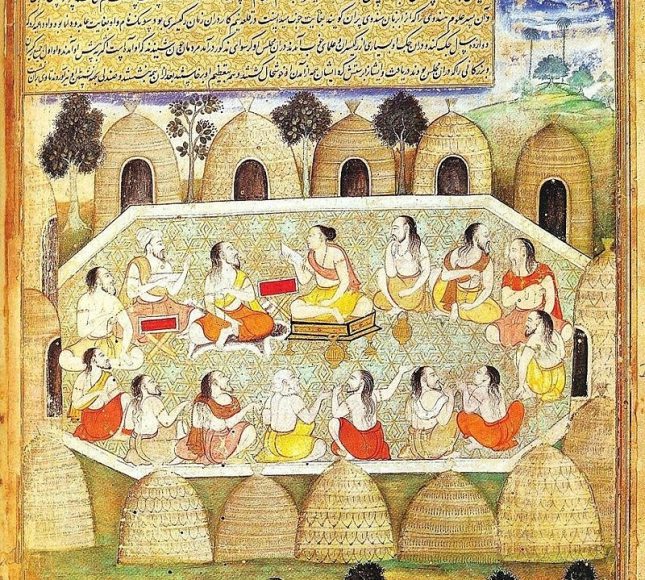
- He is the one who organized the Satra Yajna (a prolonged sacrificial ritual) in Naimisharanya, during which the epic Mahabharata was narrated by Ugrasrava Sauti, the son of Lomaharshana.
Contributions to Vedic Knowledge:
- Saunaka is credited with compiling and systematizing the Rigveda, one of the four Vedas, ensuring its preservation for future generations.
- He is also associated with the Brihaddevata, a text that explains the deities of the Rigveda.
Mentorship:
- Saunaka is known as the teacher of Katyayana, a prominent grammarian and scholar of ancient India.
- His role as a mentor highlights his dedication to nurturing and spreading spiritual and intellectual knowledge.
Symbolism:
- Saunaka represents the ideal of a sage who balances devotion, scholarship, and the responsibility of guiding others on the path of righteousness.
Saunaka’s legacy as a sage and scholar continues to inspire those who seek wisdom and spiritual growth.


